
 Facebook
 X
X
 Pinterest
 Copy Link
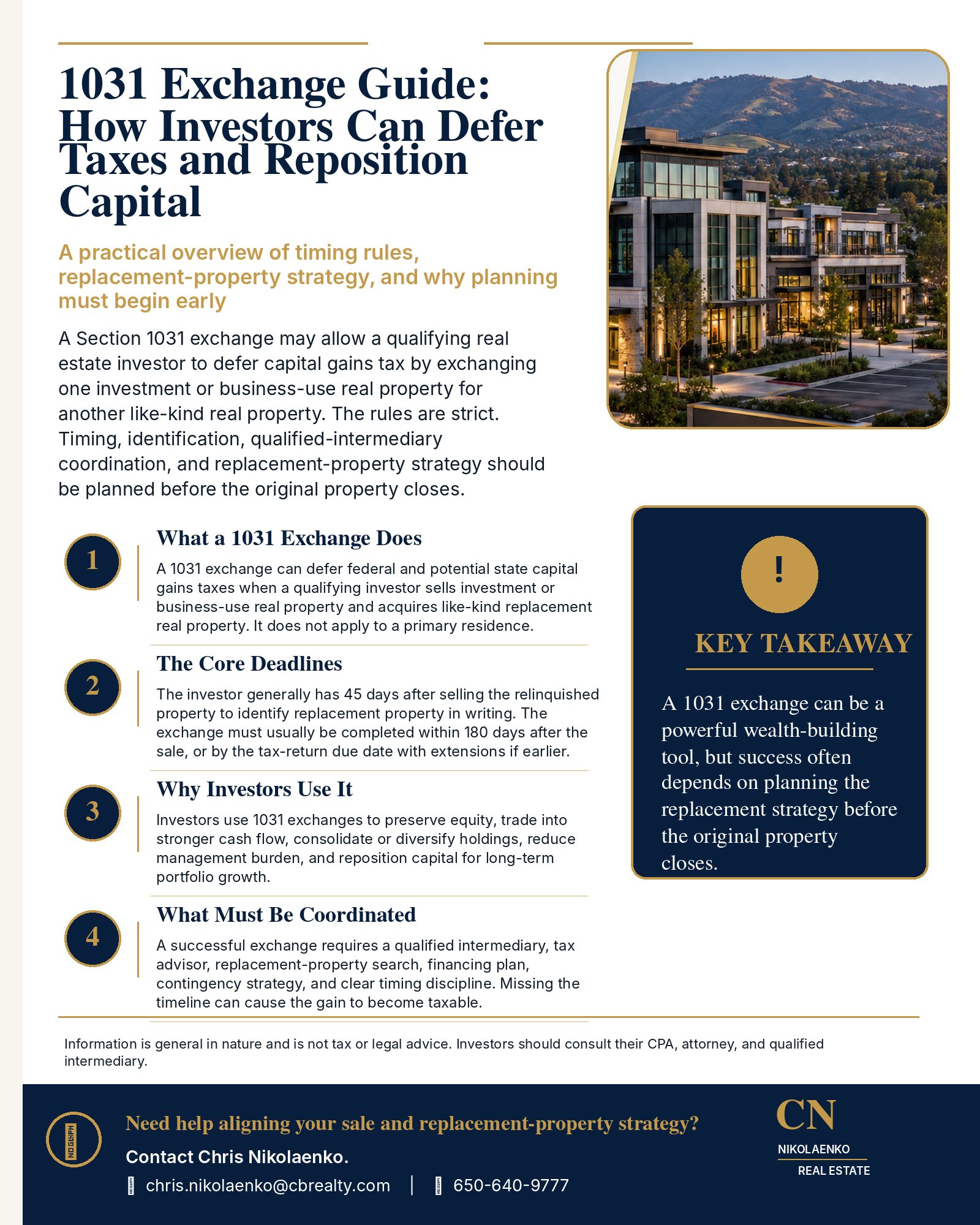

If you own an investment property in Silicon Valley, one of the most valuable tools available to you is the 1031 exchange. Named after Section 1031 of the Internal Revenue Code, it lets you sell an investment or business property and reinvest the proceeds into another qualifying property while deferring the capital gains taxes you would normally owe at the time of sale.
In a market where property values have climbed steeply over the years, that deferred tax bill can be significant. A 1031 exchange gives investors a way to reposition their holdings without losing a large chunk of their equity to taxes in the year they sell.
What a 1031 Exchange Actually Does
When you sell an investment property at a gain, you typically owe federal capital gains tax, possible state tax, and depreciation recapture. A properly structured 1031 exchange defers those taxes as long as you roll the full proceeds into a new like-kind property. The key word is defer. You are not erasing the tax, you are postponing it, and many investors continue exchanging property after property for years while keeping their capital fully invested.
The Core Rules You Need to Know
The IRS sets strict requirements, and missing a deadline can disqualify the entire exchange. Both the property you sell and the one you buy must be held for investment or business use, not as a personal residence. The replacement property generally needs to be of equal or greater value to fully defer the tax.
Two timelines matter most. You have 45 days from the sale of your original property to formally identify potential replacement properties in writing. You then have 180 days from that same sale date to close on the replacement property. These clocks run at the same time and they do not pause for weekends or holidays.
You also cannot touch the money in between. The proceeds must be held by a qualified intermediary, a neutral third party who handles the funds and paperwork so the transaction meets IRS requirements.
Why It Matters in Silicon Valley
Local investors often hold property that has appreciated far beyond its original purchase price. Selling outright can trigger a large tax event. A 1031 exchange lets you trade up into a larger building, move into a different asset class, or relocate your investment to a market with stronger cash flow, all while keeping your equity working for you.
A Few Things to Watch
Timing is everything, and the identification and closing deadlines are firm. It also helps to line up your replacement property early, since inventory can be tight. Any cash you pull out of the deal, known as boot, is generally taxable. And because the rules are detailed, you will want a qualified intermediary and a tax professional involved from the start.
Thinking About an Exchange?
Every situation is different, and this is general information rather than tax or legal advice. If you are considering selling an investment property and want to explore whether a 1031 exchange fits your goals, I can help you plan the sale, find qualifying replacement properties, and coordinate with your tax advisor and intermediary so the timeline stays on track. Reach out any time and we can talk through your options.
